Conversations: That Win the Complex Sale by Peterson Erik & Riesterer Tim
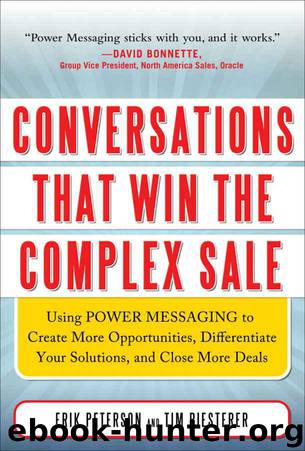
Author:Peterson, Erik & Riesterer, Tim [Riesterer, Tim]
Language: eng
Format: epub
Publisher: McGraw-Hill
Published: 2011-03-17T14:00:00+00:00
And on, and on, and on.
This creates stories with too much information that say nothing (or very little) that’s important.
The more powerful way to tell a customer story is through the use of telling details. Telling details are pieces of information that tell you a lot with just a few words.
Tom Wolfe, the author of The Bonfire of the Vanities and The Right Stuff, put it this way in an interview. He said, “You can tell a lot about a character just by the shoes he’s wearing.”
What would be an example of a telling detail in a customer story? Here are a few.
We were working with a company that supplies filter bags to businesses like cement companies. These filter bags are similar to the ones you have in a vacuum cleaner, but obviously are much larger and more highly engineered. They go inside of the “baghouse” for these big pieces of equipment.
When we worked with the company on its customer stories, they gave us one that was pretty good. It had contrast and proof, but it was a little dry.
After the salesperson had finished sharing the story, and we were moving on to another story, he turned to the person next to him and said, “You know what I love about this customer? Before they started using our bags, they used to have what they called ‘baghouse parties’ once a month. (This was a big joke, like a moving party or something else that nobody wants to do.) They would make a bunch of their people come in on the weekends and change out the old filter bags.”
Interestingly, as far as this salesperson was concerned, he’d already given us what we needed to know about this customer story. But we jumped on this concept of “bag-house parties” immediately. We asked if the customer had to hold those baghouse parties anymore now that they had started using this salesperson’s solution, and the salesperson said no.
Baghouse parties is an example of a telling detail. When you can tell a customer story by saying that the company used to have to hold baghouse parties once a month, and now they don’t have to hold them anymore, you’ve told your customer a tremendous amount in very few words. Your customer can imagine what that situation must have been like, and what it would mean to have that problem go away.
When we worked with a company that has a software platform for managing time, labor, and benefits, one of the stories they wanted to work on was about their impact on a large health-care organization. They told that story like so many others: the customer had (fill-in blank) locations, specialized in (fill-in blank) medicine, and so on.
But while we were working on the story with people from the company, they told us (almost in passing) that this health-care organization had won an award as one of the top places in the United States for nurses to work. Remember, what our customer did was implement time, labor, and benefits solutions.
Download
This site does not store any files on its server. We only index and link to content provided by other sites. Please contact the content providers to delete copyright contents if any and email us, we'll remove relevant links or contents immediately.
Influence: The Psychology of Persuasion by Robert B. Cialdini(4800)
The Miracle Morning by Hal Elrod(4734)
The Hacking of the American Mind by Robert H. Lustig(4387)
Pre-Suasion: A Revolutionary Way to Influence and Persuade by Robert Cialdini(4236)
Unlabel: Selling You Without Selling Out by Marc Ecko(3668)
Ogilvy on Advertising by David Ogilvy(3629)
Hidden Persuasion: 33 psychological influence techniques in advertising by Marc Andrews & Matthijs van Leeuwen & Rick van Baaren(3570)
Purple Cow by Seth Godin(3208)
Who Can You Trust? by Rachel Botsman(3136)
Kick Ass in College: Highest Rated "How to Study in College" Book | 77 Ninja Study Skills Tips and Career Strategies | Motivational for College Students: A Guerrilla Guide to College Success by Fox Gunnar(3132)
The Marketing Plan Handbook: Develop Big-Picture Marketing Plans for Pennies on the Dollar by Robert W. Bly(3070)
This Is Marketing by Seth Godin(3040)
I Live in the Future & Here's How It Works by Nick Bilton(3002)
The Power of Broke by Daymond John(2992)
The Tipping Point by Malcolm Gladwell(2931)
Building a StoryBrand by Donald Miller(2918)
The 46 Rules of Genius: An Innovator's Guide to Creativity (Voices That Matter) by Marty Neumeier(2859)
Draw to Win: A Crash Course on How to Lead, Sell, and Innovate With Your Visual Mind by Dan Roam(2789)
Market Wizards by Jack D. Schwager(2705)
